



















Rizzio Casino review
Editor's Choice| Key Feature | 12,000+ games across 75 studios |
| Welcome Bonus | 200% up to $4,000 CAD, 3 deposits |
| Min. Deposit | $20 CAD |
| Number of Games | 12,000+ games |
| Game Providers | Evolution, NetEnt, Hacksaw Gaming, BGaming, Betsoft |
| Payment Methods | Interac, cards, e-wallets, crypto |
| Payment Services | Interac e-Transfer, Visa, Mastercard, Skrill, Bitcoin, Ethereum, USDT |
| Mobile App | Browser-based only, no native app |
| VIP Program | Not published on site or T&Cs (verified 07 Jul 2026) |
| RTP | 96% average across slots |
| License | Anjouan Gaming Board, Comoros |
| Operator | Green Champions Leader SRL, Costa Rica |
| Launch Date | 2025 |
| Legal Age | 18+ |
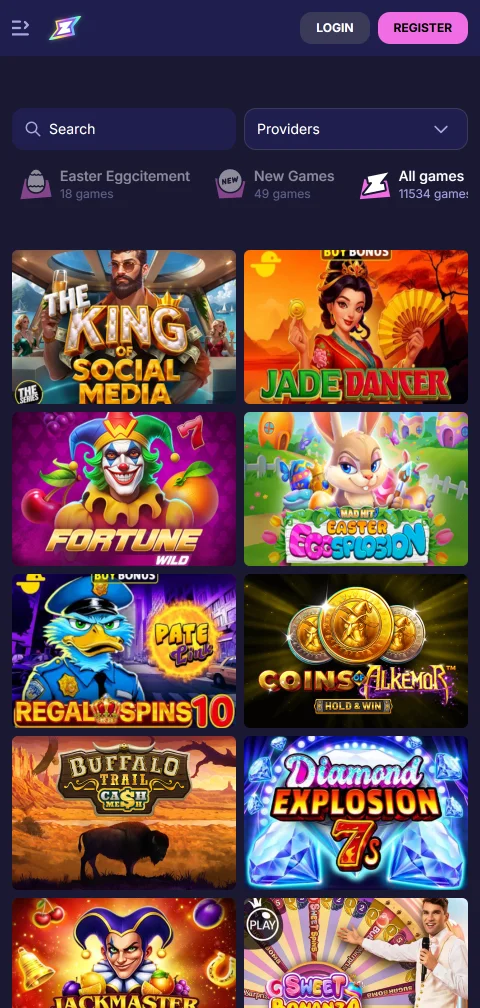

- Library exceeds 12,000 titles across roughly 75 studios.
- Interac e-Transfer supports same-day CAD deposits and withdrawals.
- Crypto cash-outs typically clear in 15 to 30 minutes.
- Three-part welcome package reaches $4,000 CAD across the first three deposits.
- Live chat runs 24/7 alongside an email queue for document-heavy issues.
- Anjouan Gaming Board licensing carries lighter oversight than AGCO-regulated operators.
- Daily withdrawal cap of EUR 500 slows access to larger wins.
- No independent eCOGRA or iTech Labs certificate published for RNG testing.
- No native iOS or Android app; browser access only.
This detailed Rizzio Casino review compares the site’s confirmed strengths — a wide game lobby and instant crypto deposits — with documented offshore weaknesses, including AskGamblers-logged withdrawal delays. Players should judge it by the parts that affect money movement, not by the homepage copy.
GG Vegas Casino review
Editor's Choice| Key Feature | Mobile-only app with daily free tournaments and GGVegas Originals |
| Welcome Bonus | 25 no-deposit spins plus up to $1,777 over five deposits |
| Min. Deposit | $5 (crypto $50) |
| Number of Games | about 2,000 games |
| Game Providers | Pragmatic Play, Play'n GO, Relax Gaming, Blueprint Gaming, Playtech, GGVegas Originals |
| Payment Methods | Interac, cards, e-wallets, Apple Pay, crypto |
| Payment Services | Interac, Visa, Mastercard, Luxon Pay, Apple Pay, Bitcoin |
| Mobile App | Native iOS and Android app (mobile-only) |
| VIP Program | Weekly 15% cashback in place of tiered VIP |
| RTP | 96.33% published payout |
| License | Isle of Man Gambling Supervision Commission |
| Operator | GG International Limited |
| Launch Date | March 2025 |
| Legal Age | 18+ |



- Isle of Man licence with BMM Test Labs auditing.
- Fair 30x wagering and 25 no-deposit spins.
- Interac and crypto deposits from just $5.
- Withdrawals aimed within 24 hours after KYC.
- Native iOS and Android app with daily free tournaments.
- Available only through the app, with no desktop site.
- Not available to players in Ontario.
- Bonus game-weighting rules are fiddlier than most rivals.
- Live tables are in-house rather than Evolution or Pragmatic Live.
In our detailed GG Vegas Casino review, the key points are clear: roughly 2,000 games, a $5 minimum deposit, and a 30x wagering requirement on bonus funds. Canadian players should compare the multi-deposit bonus with the game-weighting rules, since contribution varies between titles and shapes the real value of the $1,777 package.
Seven Casino review
Editor's Choice| Key Feature | No-wagering 10% cashback with broad crypto and Interac banking |
| Welcome Bonus | 10% cashback on losses, no wagering |
| Min. Deposit | about $20 CAD |
| Number of Games | around 2,500 games |
| Game Providers | Pragmatic Play, Evolution, Wazdan, Hacksaw, Playson (18 total) |
| Payment Methods | Cards, e-wallets, bank transfer, crypto, Klarna (25 total) |
| Payment Services | Visa, Mastercard, Interac, Skrill, Neteller, Bitcoin, Klarna |
| Mobile App | Mobile browser only, iOS and Android compatible |
| VIP Program | Daily and weekly promotions for existing players |
| RTP | around 96% average across slots |
| License | Anjouan Gaming, Comoros |
| Operator | Rabocse Sociedad de Responsabilidad Limitada |
| Launch Date | 2023 |
| Legal Age | 18+ |

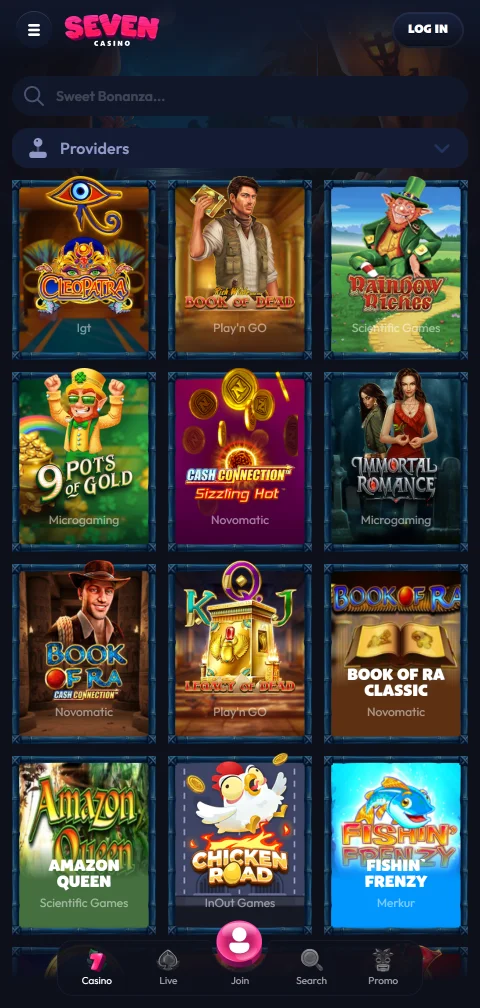

- Around 2,500 games with Evolution live tables and 18 studios.
- 25 banking methods including Interac, Klarna, and major crypto.
- 10% cashback carries no wagering and instant withdrawal of returns.
- Browser build keeps the full lobby on iPhone and Android.
- Support runs 24/7 across 12 languages, rated good by third parties.
- Anjouan (Comoros) licence offers weak player recourse.
- Very low independent Safety Index of 1.5 signals real risk.
- High volume of denied-payout complaints on record since 2023.
- Withdrawals capped at EUR 1,000 per day and EUR 2,000 weekly.
Seven Casino player guide coverage suits readers who want the operational facts first. Seven Casino player guide points to strengths in game breadth and payment choice, while flagging the Comoros licence and the high volume of payout complaints. Canada players should treat those limits as the cost of entry.
Winshark Casino review
Editor's Choice| Key Feature | 10,000+ games with 100-level VIP club |
| Welcome Bonus | 100% up to C$970 + 250 free spins |
| Min. Deposit | C$10 |
| Number of Games | 10,000+ games |
| Game Providers | Pragmatic Play, Play'n GO, Hacksaw Gaming, Games Global, NetEnt, Evolution |
| Payment Methods | Interac, cards, e-wallets, crypto, prepaid |
| Payment Services | Interac, Visa, Mastercard, Skrill, Neteller, MuchBetter, Neosurf, Bitcoin |
| Mobile App | Browser and PWA; no native iOS or Android app |
| VIP Program | 100 levels, five ranks, up to 15% cashback |
| RTP | around 96% average RTP |
| License | Curacao GCB, OGL/2024/589/0556 |
| Operator | GBL Solutions N.V. |
| Launch Date | 2024 |
| Legal Age | 18+ |
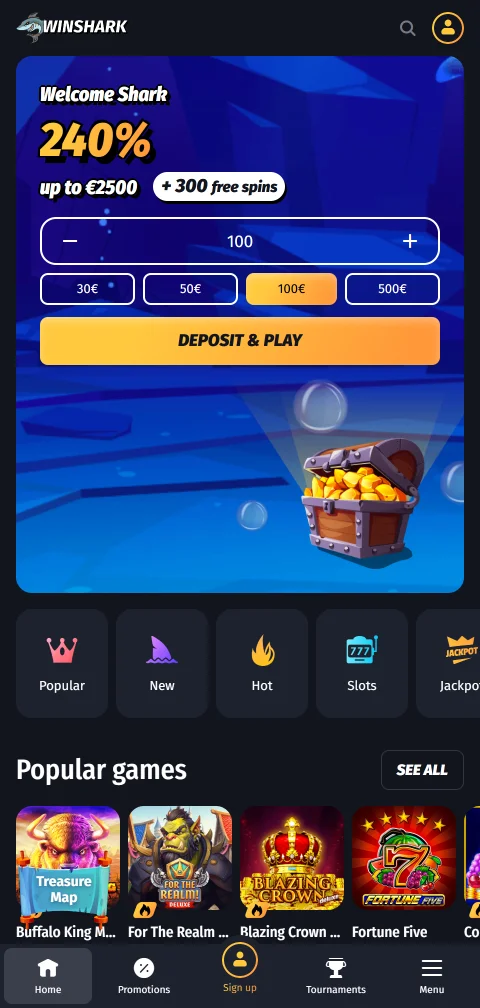
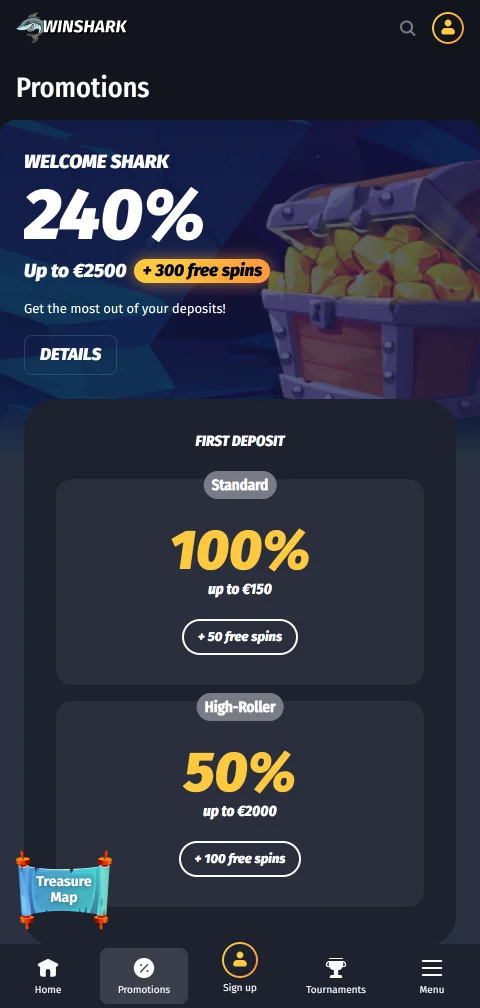

- Verified library of over 10,000 games from 100-plus providers.
- Welcome offer of 100% up to C$970 plus 250 free spins.
- Interac e-Transfer, cards, e-wallets, and crypto all supported for Canada.
- Browser and PWA access with no forced native download.
- Licensed by the Curacao Gaming Control Board under OGL/2024/589/0556.
- Welcome bonus carries a steep 45x wagering requirement.
- Bonus funds must clear within a five-day window.
- Monthly withdrawal cap starts at C$16,000 until VIP levels lift it.
- Withdrawal limits per transaction top out near C$800 on most methods.
This detailed Winshark Casino review is built for Canada players who want more than a skim. We examine withdrawal timing of 1 to 3 days, KYC friction, and the 45x wagering that decides whether the C$970 welcome bonus is usable or merely presentable.
Lemon Casino review
Editor's Choice| Key Feature | Curacao-licensed casino with 4,800+ games |
| Welcome Bonus | 100% up to 300 CAD + 100 spins |
| Min. Deposit | 10 CAD |
| Number of Games | 4,800+ games |
| Game Providers | Pragmatic Play, NetEnt, Evolution, Nolimit City, BGaming |
| Payment Methods | Credit cards, e-wallets, crypto, Interac |
| Payment Services | Visa, Mastercard, Skrill, Neteller, Interac e-Transfer, Bitcoin |
| Mobile App | Mobile browser only, no native app |
| VIP Program | Treasure Boxes loyalty programme |
| RTP | Around 96% average RTP |
| License | Curacao licence 5536/JAZ |
| Operator | Orange Entertainment B.V. |
| Launch Date | 2021 |
| Legal Age | 18+ |


- Curacao licence 5536/JAZ is publicly verifiable, unlike unlicensed rivals.
- Welcome package of 100% up to 300 CAD plus 100 spins gives a solid start.
- Interac e-Transfer support makes CAD deposits genuinely straightforward.
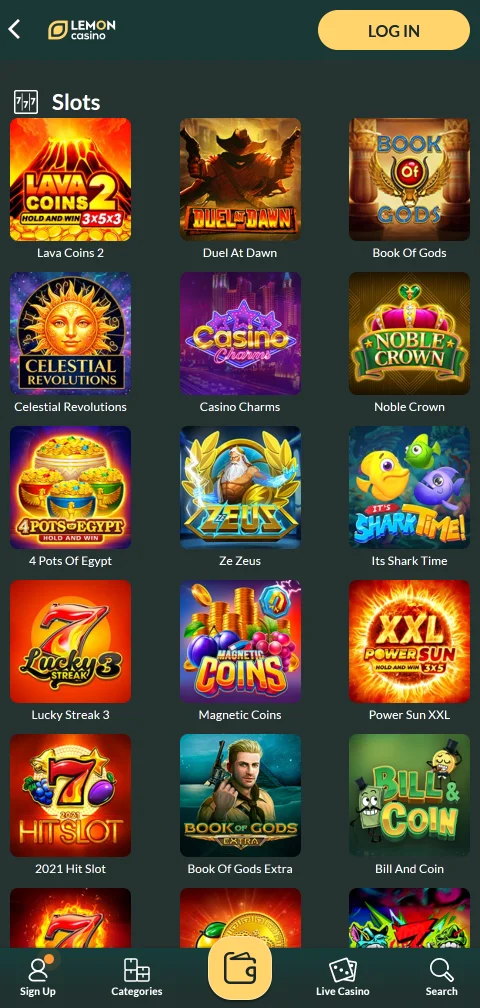
- Library of 4,800+ games covers slots, live tables, and specialty titles.
- Live chat support runs 24/7, which speeds up basic account queries.
- Withdrawals can stretch to 5 days for slower banking methods.
- Wagering requirements on the welcome bonus need careful reading before claiming.
- No confirmed native iOS or Android app, only browser-based mobile play.
- VIP tier structure details are thin compared with top-tier regulated operators.
Read our Lemon Casino player guide for a practical look at what Canada players should verify first: the confirmed licence, the 35x wagering on the welcome bonus, and the Interac-supported payment menu. A documented licence is a start; the wagering math decides the real value.
How We Rate New Online Casinos in Canada
Our editorial team rates new online casinos using objective, data-driven criteria tailored to the Canadian market. We independently verify compliance with provincial regulations, test features, and analyze player impacts across regions like Ontario and Alberta.
Licensing & Compliance
Compliance decides the top ranking. We confirm registration with iGaming Ontario under AGCO, or with Alberta’s AiGC following the 13 July 2026 launch, alongside recognised Kahnawake licences. Verified operators enforce KYC identity checks, AML transaction monitoring, and segregated player funds. New casinos that delay verification or skip integration with centralized self-exclusion lose points, since these gaps expose Canadian players to disputed payouts and weaker legal recourse.
Games & Software Variety
Depth and fairness carry equal weight here. We reward catalogues exceeding 9,000 titles that pair slots with live-dealer tables and progressive jackpots. RTP transparency above 96% and third-party testing must be documented. Content from Evolution, Pragmatic Play, and NetEnt signals credible aggregation. We confirm smooth mobile rendering on iOS and Android, plus Megaways and blackjack variants Canadian players actively search for.
Banking & Payout Speed
Cash-out speed shapes daily satisfaction. We require native CAD support, Interac availability, and withdrawals settling within 48 hours. E-wallets often clear in under two hours; bank transfers run one to three business days. New casinos are scored on fees, limits, and processing consistency. Ontario and Alberta operators face the toughest scrutiny, where fast, transparent payouts distinguish serious platforms from grey-market alternatives charging conversion fees.
Bonuses & Promotions
Real value beats headline numbers. We calculate the achievable worth of welcome offers up to C$1,000 across staged deposits, favouring wagering requirements at or below 40x. Provincial customisation matters, since Alberta’s C$150,000 registration cost influences promotional generosity. New casinos must state game weighting, expiry windows, and maximum bets plainly. Hidden restrictions or 50x-plus playthrough conditions push an operator down our ranking for Canadian players.
UX & Mobile Optimization
Mobile-first design is now the baseline. We test intuitive navigation, load times under three seconds, and responsive layouts on iOS and Android. New entrants should deliver app-quality access without heavy downloads. English and French language support widens reach across provinces. Given that mobile drives the majority of Ontario’s roughly $98 billion in 2025 wagers, we treat weak handheld performance as a serious competitive shortfall.
Customer Support & Responsible Tools
Support and safeguards protect the player. We require 24/7 live chat resolving within two minutes, plus deposit limits, session reminders, and self-exclusion. Alberta and Ontario mandate integration with centralized self-exclusion covering online and land-based venues. New casinos must surface problem-gambling resources and honour cooling-off requests promptly. Multilingual assistance and documented complaint handling confirm an operator takes Canadian regulatory duties seriously.


Rizzio Casino
Three-part welcome packageEditor's Choice
Seven Casino
Cashback welcome offerEditor's Choice
Spinko Casino
Welcome BonusEditor's ChoiceUnderstanding New Online Casinos in Canada
New online casinos are platforms recently launched or overhauled for Canadian players, and provincial law decides who may reach them. Ontario’s iGaming Ontario framework, live since April 2022, lets private operators run under AGCO and drove roughly $98.3 billion in 2025 wagers. Alberta opened its own private market on 13 July 2026, run by the Alberta iGaming Corporation with AGLC as regulator. BC’s PlayNow and Quebec’s Loto-Québec keep their monopolies. This patchwork forces players to confirm provincial compliance first.
Provincial Regulatory Landscape
Each province sets its own access rules. Ontario’s open model supports many operators under KYC, AML, and mandatory player protections. Alberta now mirrors that structure, though AGLC uniquely acts as both operator of Play Alberta and regulator. A 3% gross-gaming-revenue deduction funds First Nations and social-responsibility programs before the 20% government share applies. BC and Quebec remain single-operator jurisdictions, so players must check site eligibility by province to avoid unlicensed exposure.
Player Impact of New Launches
New platforms bring wider libraries, quicker payouts, and CAD/Interac support, but benefits vary by region. Ontario and Alberta players see genuine competition; monopoly provinces see less. Our analysis confirms some sites exceed 9,000 games with RTPs above 96%. Interac deposits post instantly and most withdrawals clear inside 48 hours, a clear gain for mobile users nationwide.
Key Features of Recent Platforms
Recent Canadian-facing casinos compete on library depth, secure banking, and documented compliance. Many catalogues now pass 9,000 titles spanning slots, live dealers, and jackpots. Interac powers instant CAD deposits, while withdrawals generally settle within 24 to 48 hours and e-wallets often clear in under two hours. Responsive HTML5 design delivers app-quality play, matching demand in Ontario and newly regulated Alberta.
Game Selection Standards
Leading newcomers stock diverse categories: Megaways video slots, blackjack and roulette variants, and live studios supplied by Evolution and Pragmatic Play. RTP transparency above 96% and third-party fairness testing reassure players, while progressive jackpots add draw. Provincial licensing dictates which suppliers appear, so Ontario- and Alberta-compliant catalogues take priority in our reviews.
| Feature | Typical Range | Canada Standard |
|---|---|---|
| Game Count | 5,000-9,000+ | 9,000+ titles |
| Withdrawal Time | 24-72 hours | Under 48 hours |
| Deposit Methods | Interac, Cards | CAD/Interac priority |
| Bonus Wagering | 30-50x | Under 40x |
| RTP Average | 95-97% | 96%+ |
| Mobile Compatibility | App/HTML5 | Full responsive |
Provincial Access vs Offshore Options
Regulated provincial platforms differ sharply from offshore sites in oversight and protections. Ontario’s AGCO/iGO model and Alberta’s AiGC framework, live since 13 July 2026, both mandate KYC, AML monitoring, and segregated funds. Grey-market offshore options operating in monopoly provinces skip these steps. Players weigh guaranteed legal recourse against broader offshore catalogues, but regulated sites deliver verified fairness and CAD-native banking without conversion fees.
Regulatory Protections
Regulated platforms enforce age verification, deposit and session limits, and centralized self-exclusion covering online and land-based venues. Offshore sites self-implement such tools inconsistently, leaving players exposed during disputes. Ontario’s roughly $98.3 billion in 2025 wagers, processed under these safeguards, shows regulated volume can scale while protection stays mandatory.
Regulated Provincial | Offshore Sites |
|---|---|
| AGCO/KYC required | Optional verification |
| CAD/Interac native | Conversion fees common |
| Player funds segregated | Varies by operator |
| Limited game access | Broader libraries |
| Responsible tools mandatory | Self-implemented |
| Provincial bonuses | Global offers |
Navigating New Platforms Safely
Verification comes first when approaching any new casino in 2026. Confirm provincial eligibility, then inspect licensing status and bonus terms before depositing. With Alberta’s market live since 13 July 2026, former grey operators are migrating to licensed status, so checking current registration matters more than ever. Session trackers and deposit limits support controlled play from the outset.
Verification Essentials
Expect government-ID scans and liveness checks that confirm age and identity within minutes on compliant sites. Review wagering requirements, kept at or below 40x on regulated platforms, plus game weighting and expiry windows. Align every choice with your province’s rules, whether Ontario’s AGCO standards or Alberta’s AiGC framework.
Verification Process
- Step 1
Confirm Provincial Access
Identify your province's rules: Ontario and Alberta permit registered private operators, while BC limits play to PlayNow and Quebec to Loto-Québec. Verify a platform's registration on the official provincial registry to ensure legal operation and enforceable player protections before creating an account. - Step 2
Check Licensing Details
Look for an active AGCO or Alberta AiGC registration, or a recognised Kahnawake licence, then cross-reference it against the official public registry. Confirm the licence status shows current, not lapsed, since Alberta's 13 July 2026 launch moved many former grey operators into fresh compliance. - Step 3
Test Banking Options
Confirm native CAD support and Interac availability, then check stated withdrawal timelines against the under-48-hour standard. Make a small first deposit to measure real processing speed and any fees. E-wallets often clear in under two hours, while bank transfers can take one to three business days. - Step 4
Review Responsible Tools
Ensure deposit limits, session reminders, and self-exclusion links work before playing, since Ontario and Alberta both require integration with centralized self-exclusion. Activate limits during signup rather than later. Confirm problem-gambling support contacts are visible and that cooling-off requests are honoured promptly.
Future Trends for Canadian Players
Alberta’s 13 July 2026 launch reshapes the national map, adding a second open market beside Ontario. Expect broader CAD payment coverage and AI-assisted responsible-gambling prompts as operators compete. Ontario’s $4.04 billion 2025 revenue signals the commercial upside other provinces now weigh, so BC and Quebec face renewed pressure to reconsider their monopolies.
Emerging Developments
Alberta’s revenue split, 80% to operators after a 3% GGR deduction, alongside its C$150,000 annual registration fee, will standardise costs among newcomers. Interprovincial player pooling remains under discussion and could deepen liquidity for poker and jackpots.
Player Preparation
Monitor AGCO and AGLC announcements as new operators clear registration. Favour platforms with documented RTP above 96% and responsive support for sustained play, rather than chasing short-lived launch promotions.
Competitive Edges
New sites compete through progressive jackpots and live studios, yet verified compliance builds lasting trust. Mobile performance, powering most of Ontario’s 2025 wagers, will keep separating serious operators from the rest.
Responsible Gambling in Canada
Responsible gambling starts with clear limits and honest self-awareness. Setting deposit, loss, and session caps before playing keeps entertainment in check, and recognising warning signs such as chasing losses or extending sessions helps players intervene early. Regulated Canadian platforms in Ontario and Alberta must integrate with centralized self-exclusion covering both online and land-based venues, and both provinces require operators to offer activity statements and time-based limit tools at signup.
Confidential support is available whenever play stops feeling like a choice. Provincial programs provide free counselling and self-exclusion, while licensed operators must display these resources and act when problem-gambling signs appear. Alberta funds social-responsibility initiatives through a share of gross gaming revenue. Activating limits early and reaching out promptly lets players keep control and treat gambling as recreation, never as income.
Key Insights on New Online Casinos in Canada
Mobile performance now defines the everyday experience. Confirmed on 18 September 2026 after AGCO data showed most of Ontario’s roughly $98 billion in 2025 wagers came through handhelds, we weight responsive design heavily. Canadians should test a new site on their phone before committing, checking load times and that responsible-gambling limits are reachable in a couple of taps.
New Online Casinos in Canada: Key Questions
What defines a new online casino in Canada?
New platforms are casinos launched or overhauled recently for Canadians, typically post-2025, often carrying over 9,000 titles and modern mobile interfaces. They must comply with provincial frameworks such as Ontario’s AGCO model, live since April 2022.
How do provincial regulations affect new casinos?
Ontario and Alberta permit private operators, while BC’s PlayNow and Quebec’s Loto-Québec keep monopolies. Alberta’s open market launched on 13 July 2026, becoming Canada’s second competitive jurisdiction and directly expanding legal access for players there.
Are new online casinos legal and safe in Canada?
Legality depends on province: Ontario and Alberta regulate through AGCO and AiGC with mandatory KYC and AML. Safety rests on verified licensing, segregated funds, and responsible tools like centralized self-exclusion, which both open markets require.
What's the difference between regulated and offshore new casinos?
Regulated sites enforce provincial protections, CAD payments, and segregated funds, keeping bonus wagering at or below 40x. Offshore platforms offer broader libraries but lack oversight, often charging conversion fees and risking slower dispute recourse for Canadians.
What payment speeds do new casinos offer Canadians?
Interac deposits post instantly, while withdrawals on compliant sites settle within 24 to 48 hours. E-wallets often clear in under two hours, and bank transfers take one to three business days, with fees varying by province.
How has the new casino market evolved in Canada?
Ontario’s 2022 launch grew to roughly $98.3 billion in 2025 wagers and $4.04 billion in gross gaming revenue. Alberta opened its private market on 13 July 2026, becoming the second open jurisdiction and lifting national competition.
What responsible features do new platforms provide?
Regulated operators must offer deposit limits, session reminders, and self-exclusion, integrating with centralized systems in both Ontario and Alberta. Platforms also provide activity statements and act on problem-gambling signs, with Alberta funding social-responsibility programs from gaming revenue.
More about online casinos



In Ontario or Alberta, an active AGCO or AiGC registration simplifies the shortlist immediately. Don’t overlook the responsible tools listed; both provinces require centralized self-exclusion, so activate deposit limits during signup for real control.