






Jackpot City Casino review
| Key Feature | Established Microgaming-powered casino |
| Welcome Bonus | 100% up to $1,600 CAD, four deposits |
| Min. Deposit | $10 CAD |
| Number of Games | 700+ |
| Game Providers | Microgaming, Evolution, NetEnt, Pragmatic Play |
| Payment Methods | Cards, e-wallets, Interac, Apple Pay |
| Payment Services | Visa, Mastercard, Interac, MuchBetter, paysafecard |
| Mobile App | iOS and Android apps |
| VIP Program | Yes, tiered loyalty |
| RTP | around 96% |
| License | Malta Gaming Authority (MGA/B2C/145/2007) |
| Operator | Bayton Ltd |
| Launch Date | 1998 |
| Legal Age | 18+ |

- Malta Gaming Authority licence, verifiable via Bayton Ltd
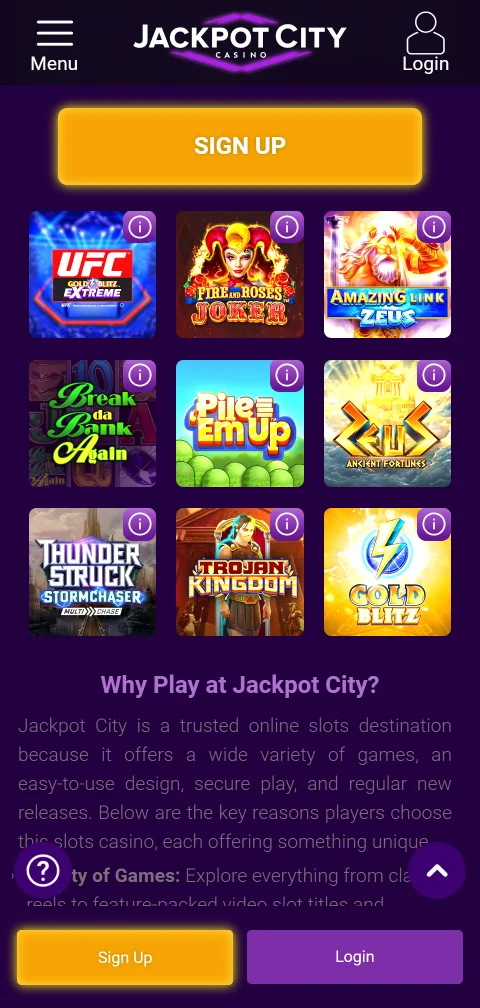
- 700+ games from Microgaming and Evolution
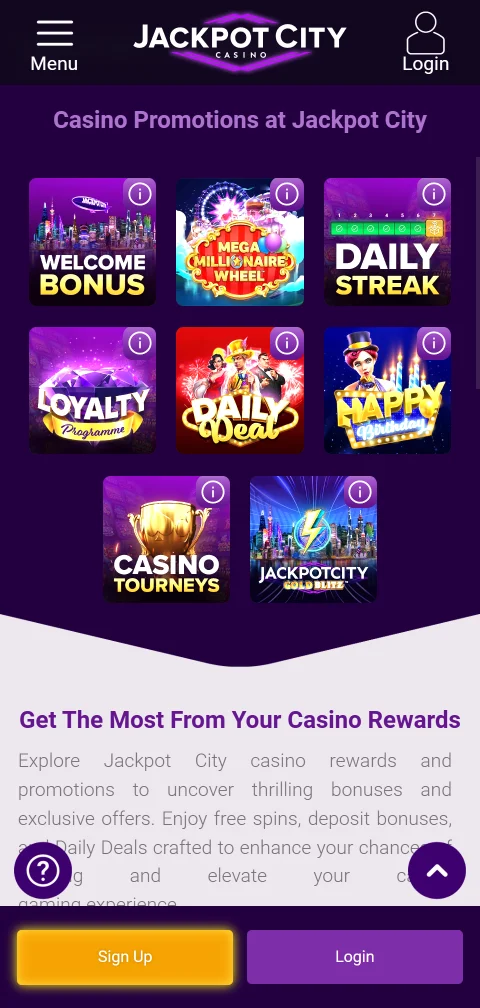
- Interac, Apple Pay and 24/7 live chat
- 35x wagering on the $1,600 CAD welcome offer
- Payouts take 2-6 days for many methods
- Ontario players routed to a separate iGO-registered site
Our Jackpot City Casino overview gives readers the essentials in one place: the 700+ games available, how Interac and Apple Pay banking work, and the support Bayton Ltd provides. It is a practical way to assess an established, MGA-regulated operator without overreading the marketing.
Spin Casino review
| Key Feature | 1,500+ games, dual MGA/Kahnawake licence |
| Welcome Bonus | Up to C$1,000 + 370 free spins |
| Min. Deposit | C$10 (C$5 on Visa) |
| Number of Games | 1,500+ games |
| Game Providers | Games Global, Evolution, Pragmatic Play |
| Payment Methods | Interac, cards, e-wallets, 11 cryptocurrencies |
| Payment Services | Visa, Mastercard, Interac, Bitcoin |
| Mobile App | iOS app plus mobile browser |
| VIP Program | Yes, six-tier loyalty programme |
| RTP | around 96.3% |
| License | Malta Gaming Authority + Kahnawake |
| Operator | Bayton Ltd, registered in Malta |
| Launch Date | 2001 |
| Legal Age | 18+ |

- 1,500+ games including 76 live-dealer tables
- Interac and 11 cryptocurrencies both supported
- iOS app plus a smooth mobile browser build
- Six-tier loyalty programme with hourly prize drops
- Withdrawals can stretch to nine days on bank rails
- 70x wagering on daily promos beyond the welcome offer
- No Ontario licence, so access is limited there
Our Spin Casino review examines the platform’s licensing, banking, and support in plain language for Canada players.
888 Casino review
| Key Feature | Large slots and live dealer lobby |
| Welcome Bonus | 100% up to C$200 |
| Min. Deposit | C$20 |
| Number of Games | 2,000+ games |
| Game Providers | 888, Evolution, NetEnt, Playtech, Microgaming |
| Payment Methods | Cards, e-wallets, bank transfer, Interac |
| Payment Services | Visa, Mastercard, Skrill, Neteller, Interac |
| Mobile App | Browser-based on iOS and Android |
| VIP Program | Tiered loyalty programme |
| RTP | Around 96% average |
| License | Malta Gaming Authority (MGA) |
| Operator | Evoke plc, Gibraltar |
| Launch Date | 1997 |
| Legal Age | 18+ |

- Large 2,000-plus game library with strong live dealer options.
- Established Evoke plc brand with MGA licensing oversight.
- Multiple Canadian-friendly payment methods, including Interac and e-wallets.
- Mobile browser runs smoothly on most iOS and Android devices.
- 24 to 48 hour payout window on e-wallet withdrawals.
- Welcome bonus wagering at 35x limits the practical value.
- Card and bank transfer withdrawals run slower than e-wallets.
- No dedicated standalone mobile app in every market.
- Support hours are not confirmed as 24/7 for all channels.
This 888 Casino editorial review looks at the operator from a Canadian perspective, with emphasis on Evoke plc’s regulatory footprint, game variety, and responsible gaming tools. It is a useful read for anyone who wants a measured summary rather than marketing language.
bet365 Casino review
| Key Feature | AGCO-licensed sportsbook-linked casino with fast Interac payouts |
| Welcome Bonus | Bet $1, get $200 bonus bets |
| Min. Deposit | $10 CAD |
| Number of Games | about 500-600 games |
| Game Providers | Evolution, Pragmatic Play, Playtech, NetEnt, Microgaming |
| Payment Methods | Interac e-Transfer, Visa, Mastercard, Apple Pay |
| Payment Services | Interac e-Transfer, Visa Direct, Mastercard, Apple Pay |
| Mobile App | Dedicated iOS and Android apps |
| VIP Program | Reload bonuses, no formal tiers |
| RTP | Varies by title, published per game |
| License | iGaming Ontario (AGCO), since April 2022 |
| Operator | Hillside (Ontario) Limited, bet365 Group |
| Launch Date | 2000 (Ontario: 2022) |
| Legal Age | 18+ |

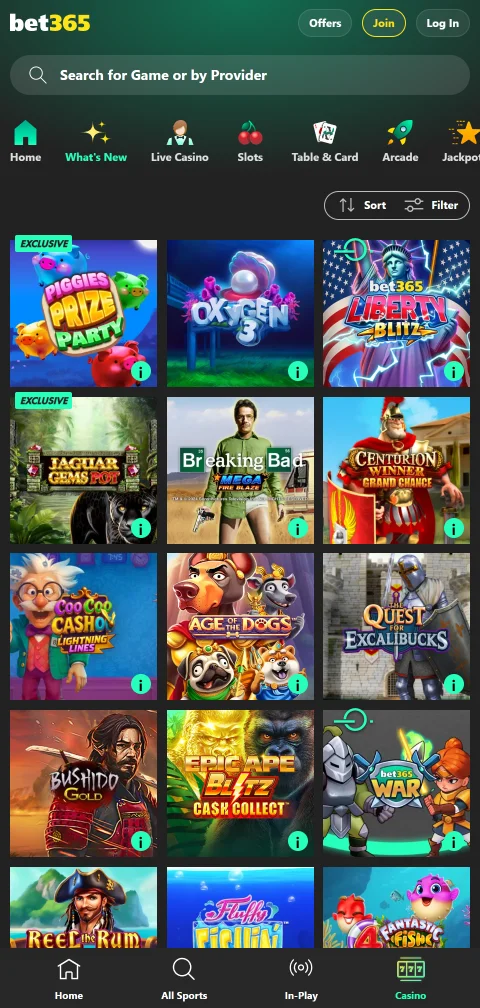
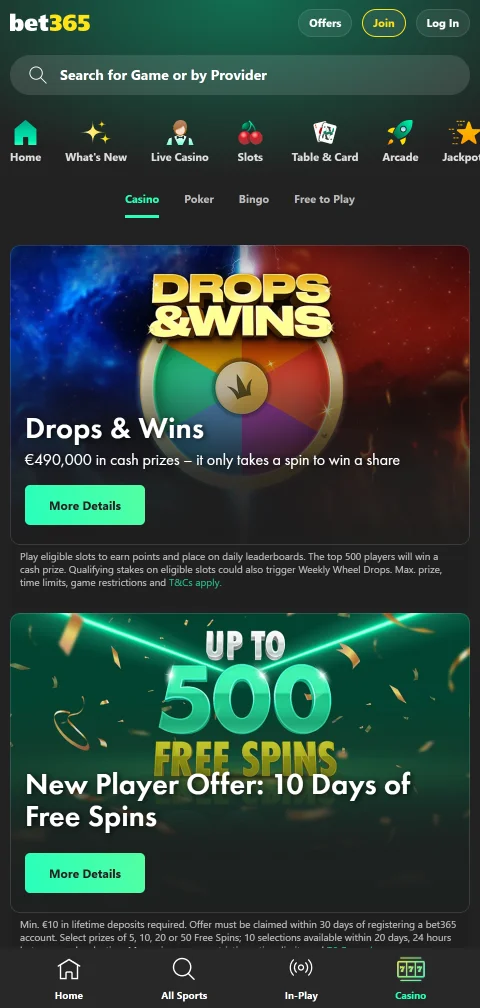
- Interac cashouts typically clear in under four hours
- AGCO-regulated under Hillside (Ontario) Limited since 2022
- 24-hour live chat support with short wait times
- Live dealer tables run on Evolution with high-roller access
- Dedicated iOS and Android apps with biometric login
- Casino welcome offer is bonus bets, not a deposit match
- Slots library of roughly 500-600 titles trails larger rivals
- No PayPal, e-wallet, or cryptocurrency support
- $5,000 per-transaction Interac withdrawal cap
Our bet365 Casino verification guide walks through what Ontario players should confirm before depositing: AGCO licence status, Interac withdrawal caps, and the KYC documents that may be requested on a first cash-out.
LeoVegas Casino review
| Key Feature | Mobile-first casino with live tables |
| Welcome Bonus | 100% up to $200 + 50 spins |
| Min. Deposit | $20 minimum |
| Number of Games | Around 2,000 games |
| Game Providers | NetEnt, Evolution, Play'n GO, Pragmatic Play, Microgaming |
| Payment Methods | Cards, e-wallets, Interac, Apple Pay, crypto |
| Payment Services | Visa, Mastercard, Skrill, Neteller, Interac e-Transfer |
| Mobile App | Mobile browser only, no native app |
| VIP Program | Yes, tiered loyalty programme |
| RTP | Around 96% |
| License | MGA/CRP/237/2013, Malta |
| Operator | LeoVegas Gaming plc (MGM Resorts) |
| Launch Date | 2011 |
| Legal Age | 18+ |

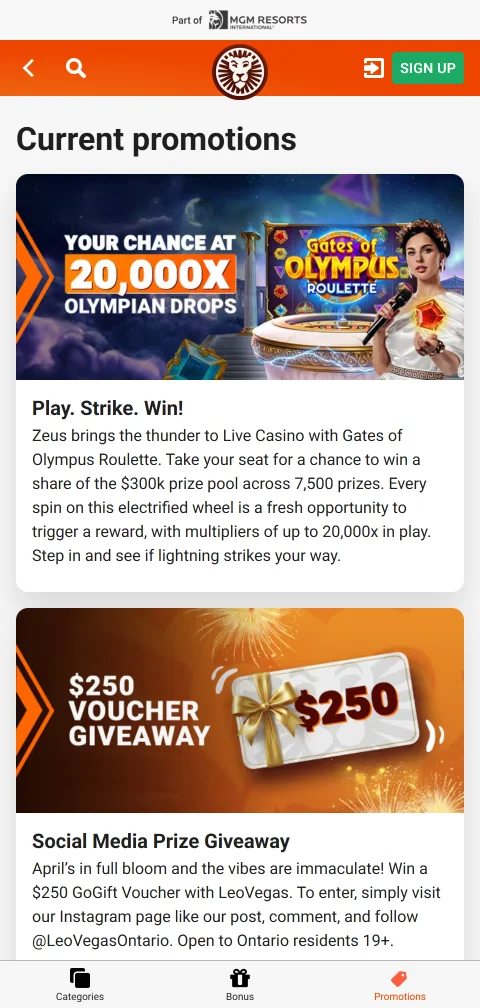
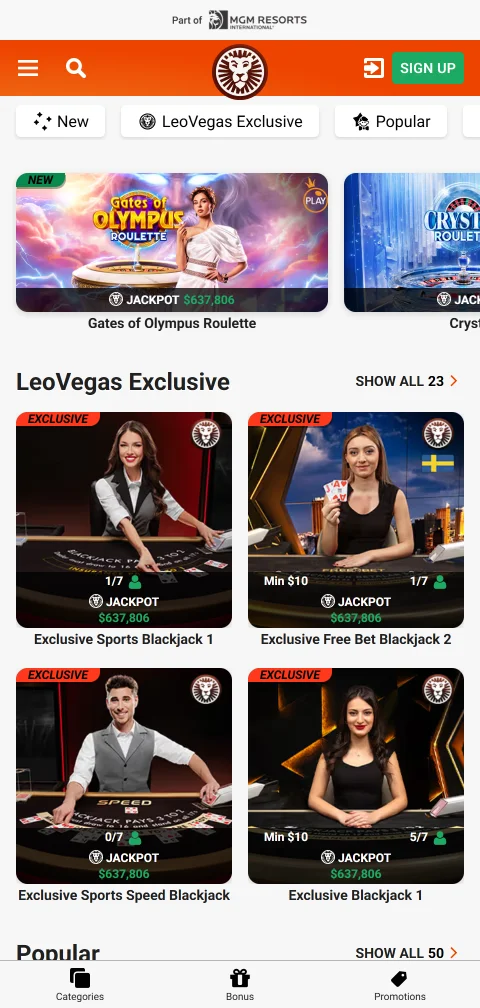
- MGA licence confirmed under number MGA/CRP/237/2013
- Evolution-powered live tables and established slot providers
- Interac e-Transfer and Apple Pay work on mobile
- Backed by MGM Resorts International since 2022
- No confirmed native mobile app, browser only
- Bonus wagering terms need careful checking before deposit
- Card withdrawals can stretch toward five business days
LeoVegas Casino feels familiar at first glance, but the review only makes sense once you test the full flow. Our LeoVegas Casino review looks at gaming variety, Interac-friendly banking, and support quality to see whether the platform is actually convenient for Canada players.
How we ranked the Ontario-registered casinos
The ranking is built from what each operator publishes for Ontario players: its terms, its cashier page, its game help files and the AGCO’s public record. Commission paid to this site does not move a placing, and neither does the size of a welcome offer.
Bonuses and how their terms are disclosed
Standard 2.06 requires every material condition of an offer at its first presentation, with the rest no more than one click away; we read whether the casino actually complies. Wagering of 30x the bonus or less, charged on the bonus alone, raises a placing. Wagering above 50x, a multiple charged on deposit plus bonus, or a maximum bet rule buried in the general terms lowers it. An offer labelled free that needs a deposit counts against the operator, because Ontario forbids that wording.
Banking, Interac and payout speed
We read the stated withdrawal window for each method in the cashier and in the terms. A stated Interac payout window of 24 hours after approval, with no withdrawal fee, raises a placing. A window longer than five business days, a fee on cashing out, or a rule sending every withdrawal to manual review lowers it. Crypto never enters this criterion, since Standard 5.69 rules it out.
Games, providers and Ontario’s slot rules
Standard 4.06 requires the operator to show the odds and its own advantage before a bet is placed. A casino where each slot’s RTP is visible from the game tile or its info screen raises a placing, while one that hides the figure inside a provider document lowers it. A library drawing on several independent studios counts in its favour; a large catalogue padded with near-identical reskins does not.
Mobile use, geolocation and the app
Every Ontario site has to confirm that you are inside the province before play. A native app on both iOS and Android, with deposit and time limits reachable from the account menu, raises a placing. Limit settings available only on desktop, or an app missing part of the browser game list, lowers it.
AGCO registration and the iGO agreement
A casino enters this list only if its exact domain appears in iGaming Ontario’s directory and its operating company appears on the AGCO’s register; the same brand name on a different domain does not qualify. Within the list, an operator with no AGCO monetary penalty in the preceding 24 months ranks above one with a recent penalty, and a registration suspension drops a site to the bottom until it is lifted. A Malta or Kahnawake licence held alongside adds nothing here.
Customer support and the complaint route
Live chat staffed around the clock and a published formal complaint process that issues a reference number raise a placing. That number is what iGaming Ontario asks for when a dispute is escalated. Email-only support, or a complaint page with no stated response time, lowers it.

How Ontario's online casino market is built
Ontario opened its regulated online market on April 4, 2022, and the Registrar’s Standards for Internet Gaming came into force the same day. Two provincial bodies stand behind every registered site, and they do different jobs.
The Alcohol and Gaming Commission of Ontario is the regulator. It writes the standards, registers operators and suppliers, registers the testing labs that certify games, and sanctions breaches through warnings, monetary penalties, suspensions or revocation. iGaming Ontario conducts and manages the games through operating agreements with private companies, which is the arrangement the Criminal Code requires when a province offers gaming through them. iGO began as a subsidiary of the AGCO and became an independent agency when the iGaming Ontario Act was proclaimed on May 12, 2025.
For a player, the practical consequence is simple: a site needs both approvals before it may accept a single Ontario wager.
The market is large enough to be measured every month. iGO’s report for July 2026 recorded $9.88 billion in wagers and $413.6 million in revenue, with casino games making up $8.78 billion of those wagers. Wagers count every recycled bet, so revenue is the closer measure of what players actually lost.
What registration requires of an Ontario casino
The table sets out five Registrar’s Standards that change what a player sees on screen, taken from the AGCO’s published text rather than from operator summaries.
| Rule area | Standard | What it requires | Effect on play |
|---|---|---|---|
| Bonus advertising | 2.05 | Offers only on-site or after opt-in | No public welcome-offer banners |
| Offer terms | 2.06 | Material conditions at first presentation | Wagering visible before accepting |
| Payments | 5.69, 5.74 | No crypto, no credit to players | Fiat methods via financial providers |
| Slot pace | 2.16, 2.18 | No autoplay, 2.5-second minimum cycle | No turbo or quick-spin modes |
| Limit setting | 2.23 | Limits for 24 hours, 7 days, one month | Lowest overlapping limit applies |
Checking an Ontario casino before you sign up
Registration is public information, and confirming it takes less time than reading a welcome offer. The check matters because brand names travel: several international operators run an Ontario site on one domain and a differently licensed site for the rest of the world on another.
What I check first is whether the address bar matches the domain listed in iGaming Ontario’s directory, not merely the brand.
The AGCO’s rules also reach the people who promote casinos. Standard 1.21 bars any third party paid to market an operator’s site from also promoting sites that take Ontario wagers without AGCO registration. A review page sending Ontario readers to an offshore casino therefore tells you something about the review page itself.
Four checks before the first deposit
These four checks use only public registers and the operator’s own pages, arranged in the order that rules a site out fastest.
- Step 1
Match the domain to iGO's directory
Open iGaming Ontario's list of regulated sites and compare the exact domain, not the brand. Ontario sites display the iGO logo, but a logo is an image anyone can copy, so the directory entry is the proof. - Step 2
Confirm the operator on the AGCO register
Find the operating company named in the site's terms and look it up in the AGCO's list of registered internet gaming operators. If the company in the footer and the company on the register differ, stop there. - Step 3
Read the bonus terms before opting in
Standard 2.06 puts material conditions at the first presentation of an offer. Note the wagering multiple, whether it applies to the bonus alone, the maximum bet while wagering, and which games count towards it. - Step 4
Set limits during registration, not later
Ontario sites must offer financial and time limits at registration, with periods of 24 hours, 7 days and one month. Setting them before the first deposit means the decision is made before any session begins.
Bonus terms under Ontario's consumer rules
Ontario does not ban bonuses. Standard 2.05 bans advertising them in public, including targeted and algorithm-based ads, and allows offers only on the operator’s own site or in direct marketing to a player who has actively opted in.
The terms themselves are where the consumer protection sits. An offer may not be called free if the player must risk their own money to use it, and a bet may not be called risk-free if a loss is possible.
The clauses that decide an offer’s value
The wagering multiple comes first, and the base it applies to matters as much as the number. A $100 bonus at 30x requires $3,000 in wagers, while the same multiple on a $100 deposit plus a $100 bonus requires $6,000. Maximum bet rules come next, because a single spin above the cap during wagering can void the bonus and whatever it produced. Game restriction clauses complete the picture: table games and live dealer titles often contribute a fraction of their stake towards the requirement, and some contribute nothing at all.
An offer is worth what its terms let you withdraw, not what its headline says.
Withdrawals, identity checks and disputes
Two rules shape how long an Ontario withdrawal takes. Standard 5.70 allows one only after the operator confirms that the request comes from the account holder and that the money goes to an account the player legally holds. Operators are also reporting entities under federal anti-money-laundering law, which is why identity verification happens before money moves rather than after.
The first withdrawal is the one that waits on verification, and completing it at sign-up removes that delay from the cash-out.
When a casino will not pay
The complaint path runs through the operator first. You file a formal complaint under the site’s own process and keep the reference number it issues, and the operator has up to 90 days to respond. If the answer is unsatisfactory or never arrives, iGaming Ontario accepts the dispute for review and acknowledges it within one business day. iGO cannot settle bets or award compensation itself, and the AGCO states plainly that it cannot recover money for a player either. What the AGCO can do is investigate a rule breach and penalise the operator, which is a different outcome from getting a balance back.
Ontario registration compared with offshore licences
Many casinos visible from Ontario hold licences from Malta, Kahnawake or Curaçao. Those licences are real regulatory instruments in their own jurisdictions, and the Malta Gaming Authority in particular runs a demanding regime. None of them authorises a site to offer games to players in Ontario, where the Criminal Code leaves that decision to the province.
The comparison below sets an Ontario-registered site against an offshore-licensed one on six points, including the one where offshore sites hold the practical edge.
Ontario-registered site | Offshore-licensed site |
|---|---|
| Authorised to offer games to players in Ontario | Not authorised for Ontario, whatever its home licence |
| Disputes escalate to iGaming Ontario after the operator | Disputes go to the foreign regulator or its ADR service |
| BetGuard self-exclusion covers every regulated Ontario site | Self-exclusion covers that operator or its group only |
| Cryptocurrency deposits refused under Standard 5.69 | Crypto deposits commonly offered |
| Games certified by AGCO-registered testing labs | Under an MGA licence, games also need independent certification |
| Mandatory limits for 24 hours, 7 days and one month | Limit options depend on the issuing regulator |
What is still changing in Ontario's rules
The Registrar’s Standards are amended in place, so a rule quoted on any review page is only as current as its last check against the AGCO’s own text.
Two amendments still shape what players see. Since February 28, 2024, active and retired athletes may not appear in Ontario iGaming advertising except to promote responsible gambling. On May 14, 2026, iGaming Ontario launched BetGuard, a single portal through which anyone 19 or over can opt out of every regulated site in the province, OLG’s included, for six months, one year, five years or a custom term.
Enforcement is the other moving part, and its decisions are published. In March 2025 the AGCO fined BetMGM Canada $110,000 after marketing companies it engaged offered cash to people for opening accounts.
Alberta opened its own private market on July 13, 2026, but an Alberta registration does not let a site serve Ontario: Standard 3.02 confines games to the province unless they are run jointly with another provincial government.
Responsible gambling on Ontario-registered sites
Every Ontario-registered casino has to let you set financial and time limits at sign-up and at any point afterwards, for periods of 24 hours, 7 days and one month. Where two limits overlap, the lower one applies. Slot design rules pull in the same direction: Ontario versions carry no autoplay and no turbo spins, and at least 2.5 seconds must pass between game cycles. If a break from one site is not enough, the province-wide self-exclusion program covers every regulated site through a single registration. The support services listed below are free and confidential.
Before you choose an Ontario casino
The figure worth keeping is 90 days: an operator has up to that long to answer a formal complaint, and iGaming Ontario steps in only after the answer, or its absence. File the complaint early and keep the reference number. The ranking above was last reviewed on 12 October 2026, and it moves whenever the AGCO publishes a penalty or suspension against a listed operator. Sports betting and peer-to-peer poker run under the same registration with additional standards, and this page deliberately leaves them out.
Questions about online casinos in Ontario
Is it legal to play at online casinos in Ontario?
Yes, at sites registered with the AGCO and operating under an iGaming Ontario agreement, plus OLG.ca. A site licensed only in Malta, Kahnawake or Curaçao has no authority to offer games in Ontario, and if a dispute arises, neither iGO nor the AGCO can act on your behalf.
Do I need to be in Ontario to play, or just live there?
You need to be physically in Ontario and at least 19. Standard 3.02 requires operators to check a player’s location before play and at intervals afterwards, and to block attempts they cannot verify. An Ontario resident visiting Quebec is blocked from real-money games on the Ontario site, even with a valid account.
Why don't Ontario casinos show welcome bonuses on their home pages?
Standard 2.05 prohibits public advertising of bonuses, credits and inducements, including targeted and algorithm-based ads. Offers may appear only on the operator’s own site or in direct marketing to a player who has opted in. The bonuses still exist; you see them after registering, with material terms disclosed at their first presentation.
Can I deposit with cryptocurrency or a line of credit?
No to both. Standard 5.69 states that cryptocurrency is not legal tender and shall not be accepted, and Standard 5.74 forbids operators from extending credit or referring players to credit providers. A site taking Bitcoin from Ontario players is, by that fact alone, outside the regulated market.
What can I do if an Ontario casino refuses a withdrawal?
File a formal complaint through the operator’s own process and keep the reference number. If there is no satisfactory answer within the operator’s service standard, up to 90 days, escalate to iGaming Ontario with the site name, your player ID and that reference. iGO reviews the dispute but cannot award compensation directly.
How does BetGuard self-exclusion work?
BetGuard, launched by iGaming Ontario on May 14, 2026, lets anyone 19 or over opt out of every regulated Ontario site, OLG’s included, through one portal. Terms run six months, one year, five years or custom. Operators must block access and new accounts, and stop marketing to that person within 24 hours of registration.
More about online casinos







Before anything else, we check the domain on each card against iGaming Ontario’s directory; a matching brand on a different address is a different site.