





















The Clubhouse Casino review
| Key Feature | Large 2,800+ game library with 26 providers |
| Welcome Bonus | 100% up to $600 CAD + 100 free spins |
| Min. Deposit | $20 CAD |
| Number of Games | 2,800+ games |
| Game Providers | Pragmatic Play, Play'n GO, Playtech, Yggdrasil, Betsoft |
| Payment Methods | Cards, e-wallets, Interac, bank transfer, crypto |
| Payment Services | Visa, Mastercard, Interac, Skrill, Neteller, Bitcoin, Ethereum |
| Mobile App | Browser-based mobile play, no app |
| VIP Program | Club points loyalty programme |
| RTP | 96% average RTP |
| License | Curaçao licence 8048/JAZ2020-13 |
| Operator | Dama N.V., Willemstad, Curaçao |
| Launch Date | 2021 |
| Legal Age | 18+ |


- A 2,800+ title library from 26 providers gives casual and regular players plenty of variety without feeling repetitive.
- Interac, e-wallets and crypto rails cover the payment options most Canada players expect, with withdrawals clearing in about 1-3 days.
- Mobile browser access mirrors the desktop lobby closely, so no dedicated app is needed to reach the full catalogue.
- The confirmed Curaçao licence and named operator, Dama N.V., give more grounding than an anonymous offshore site.
- Support runs 24/7 through live chat and email, which is serviceable though it stops short of a phone line.
- Ontario residents cannot access The Clubhouse Casino because the operator has not obtained an AGCO/iGaming Ontario licence.
- The 40x wagering requirement and 7-day claim window on the welcome package require careful planning to clear.
- The minimum deposit sits at $30 CAD for bonus-eligible deposits, which is higher than some Canadian-facing competitors.
- Evolution Gaming is absent from the live casino, even though the 311-title live lobby covers most other major suppliers.
Our The Clubhouse Casino review focuses on the basics that most players check first: licensing, deposit methods, withdrawal timing, and game access. When a casino publishes clear operator and licence information, the safest way to assess it is to trace those operational facts, then compare them against everyday play, not the marketing claims around them.
Golisimo Casino review
| Key Feature | 12,000+ games across 124+ providers |
| Welcome Bonus | 100% up to $1,000 CAD + 200 free spins |
| Min. Deposit | about $15 CAD |
| Number of Games | 12,000+ games |
| Game Providers | Pragmatic Play, Playtech, Microgaming, Hacksaw Gaming, BGaming |
| Payment Methods | Cards, Interac, e-wallets, crypto |
| Payment Services | Visa, Mastercard, Interac, Skrill, Neteller, Bitcoin |
| Mobile App | Mobile browser only, no native app |
| VIP Program | Five-tier VIP loyalty ladder |
| RTP | around 96% average RTP on slots |
| License | Unlicensed; no regulator confirmed |
| Operator | Not disclosed publicly |
| Launch Date | 2026 |
| Legal Age | 18+ |
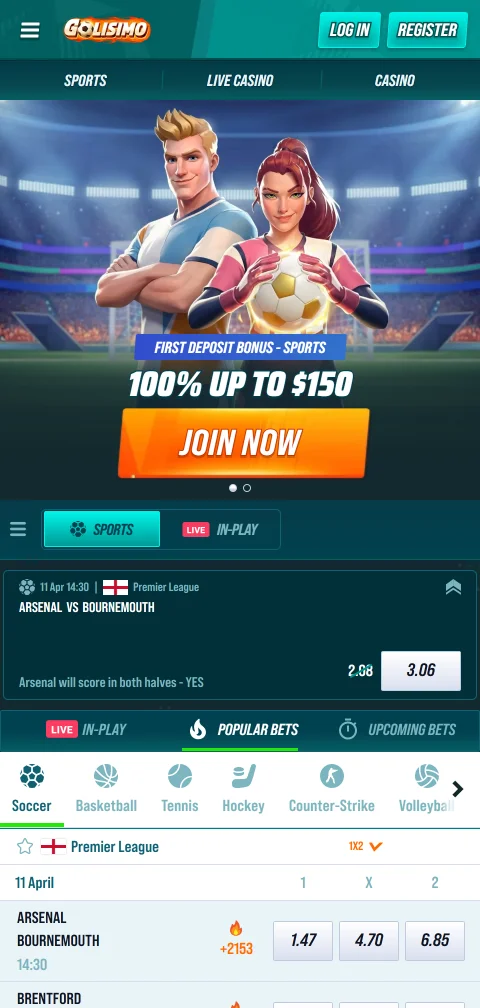

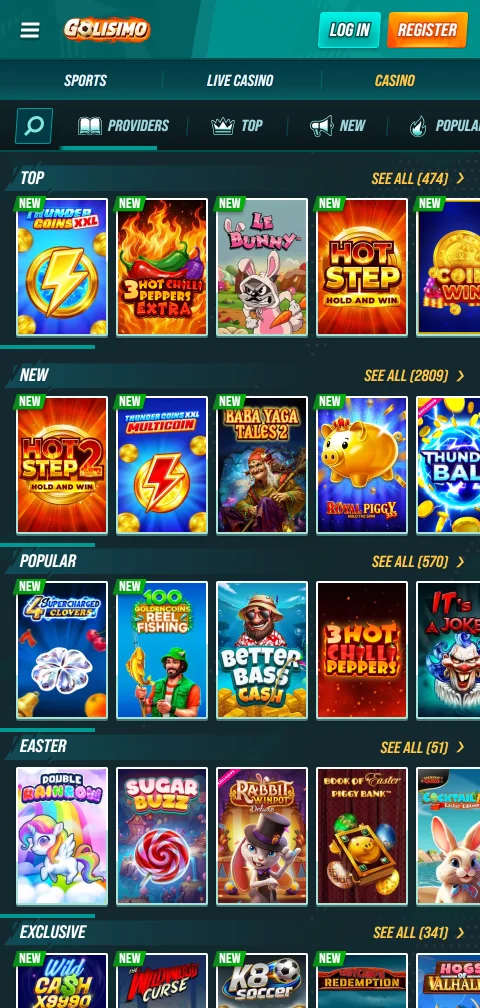
- Deep catalogue of 12,000+ games from 124+ studios.
- Interac e-Transfer, cards, e-wallets and eleven cryptocurrencies supported.
- E-wallet withdrawals process instantly once KYC clears.
- Instant-play site runs smoothly on iPhone and Android browsers.
- Five-tier VIP ladder adds cashback and higher limits.
- Operator holds no confirmed gambling licence anywhere.
- Monthly withdrawal capped at C$10,500, daily at C$750.
- Ontario players are blocked from registering entirely.
- Casino Guru rates the terms and conditions somewhat unfair.
Our Golisimo Casino player guide is aimed at Canadians weighing convenience against risk. The cashier supports Interac, cards, e-wallets and crypto, and mobile play runs through the browser with no app needed. The trade-off is a missing licence and a C$10,500 monthly cap, plus a hard block on Ontario accounts.
Just Casino review
Editor's Choice| Key Feature | Large-scale Curaçao-licensed casino |
| Welcome Bonus | 150% up to $750 CAD + 100 FS |
| Min. Deposit | $20 |
| Number of Games | 14,000+ |
| Game Providers | Pragmatic Play, Evolution, Playtech, NetEnt, Hacksaw |
| Payment Methods | Cards, e-wallets, crypto, Interac |
| Payment Services | Visa, Mastercard, Interac, Skrill, MuchBetter, Bitcoin |
| Mobile App | iOS and Android app |
| VIP Program | Yes, invite-only VIP club |
| RTP | about 96.5% |
| License | Curaçao GCB OGL/2024/164/0246 |
| Operator | Just Entertainment B.V. |
| Launch Date | 2023 |
| Legal Age | 18+ |


- 14,000+ games spanning slots, live tables, and specialty titles
- Crypto and Interac withdrawals typically clear within 24 hours
- Dedicated iOS and Android apps alongside full mobile browser access
- Curaçao licence means no AGCO or Kahnawake oversight for CA players
- 40x wagering applies across the five-stage welcome package
- Live chat routes through an AI agent before reaching a human
Our Just Casino review examines the site’s structure from a trust-and-utility angle. The lobby, payment options, and support approach all matter, but the key issue is whether Canada players can move from deposit to withdrawal without unnecessary friction under the Curaçao licence framework.
LeoVegas Casino review
| Key Feature | Mobile-first casino with live tables |
| Welcome Bonus | 100% up to $200 + 50 spins |
| Min. Deposit | $20 minimum |
| Number of Games | Around 2,000 games |
| Game Providers | NetEnt, Evolution, Play'n GO, Pragmatic Play, Microgaming |
| Payment Methods | Cards, e-wallets, Interac, Apple Pay, crypto |
| Payment Services | Visa, Mastercard, Skrill, Neteller, Interac e-Transfer |
| Mobile App | Mobile browser only, no native app |
| VIP Program | Yes, tiered loyalty programme |
| RTP | Around 96% |
| License | MGA/CRP/237/2013, Malta |
| Operator | LeoVegas Gaming plc (MGM Resorts) |
| Launch Date | 2011 |
| Legal Age | 18+ |

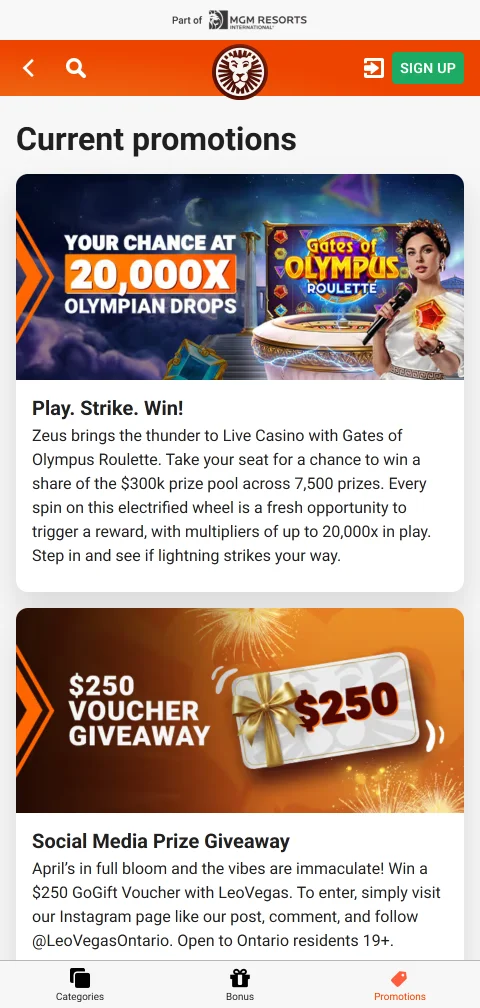
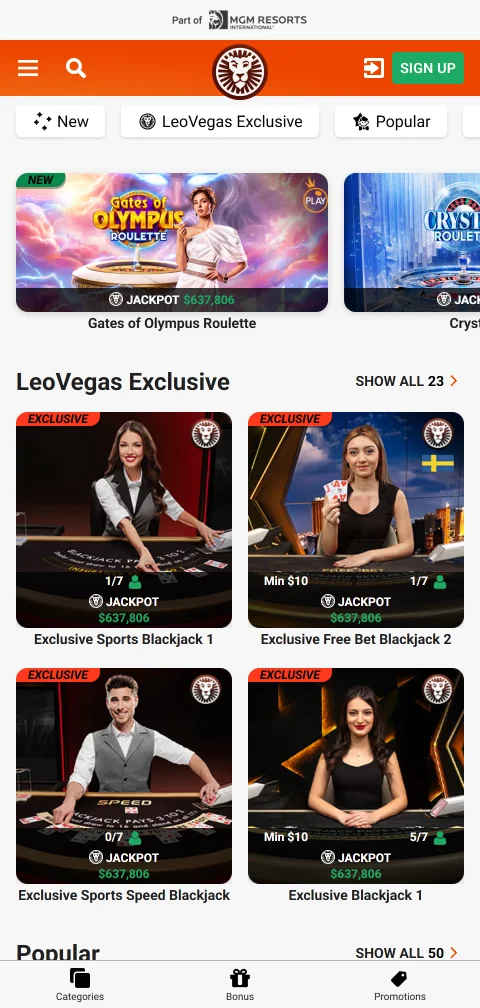
- MGA licence confirmed under number MGA/CRP/237/2013
- Evolution-powered live tables and established slot providers
- Interac e-Transfer and Apple Pay work on mobile
- Backed by MGM Resorts International since 2022
- No confirmed native mobile app, browser only
- Bonus wagering terms need careful checking before deposit
- Card withdrawals can stretch toward five business days
LeoVegas Casino stands out most when the essentials work together, and our LeoVegas Casino in-depth look covers exactly that. We break down the lobby, payments, mobile use, and support so Canada players can judge whether the site is genuinely convenient or just well presented.
Casumo Casino review
| Key Feature | Native iOS and Android apps with biometric login |
| Welcome Bonus | 100% up to $500 + 115 free spins |
| Min. Deposit | $10 CAD |
| Number of Games | Over 5,300 titles |
| Game Providers | Pragmatic Play, Play'n GO, NetEnt, Playtech, Microgaming |
| Payment Methods | Interac, cards, e-wallets, prepaid, bank transfer |
| Payment Services | Interac e-Transfer, Visa, Mastercard, MuchBetter, Paysafecard |
| Mobile App | Yes, native iOS and Android apps |
| VIP Program | Loyalty rewards with Valuables and Reel Races |
| RTP | About 96% average RTP |
| License | Malta Gaming Authority (MGA/CRP/217/2012/05) |
| Operator | Recro Limited, Malta |
| Launch Date | 2012 |
| Legal Age | 18+ |
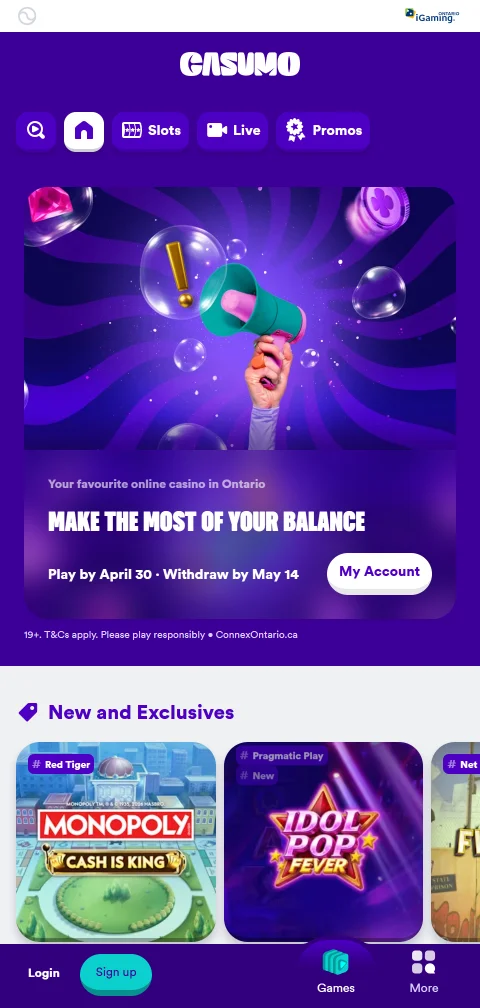
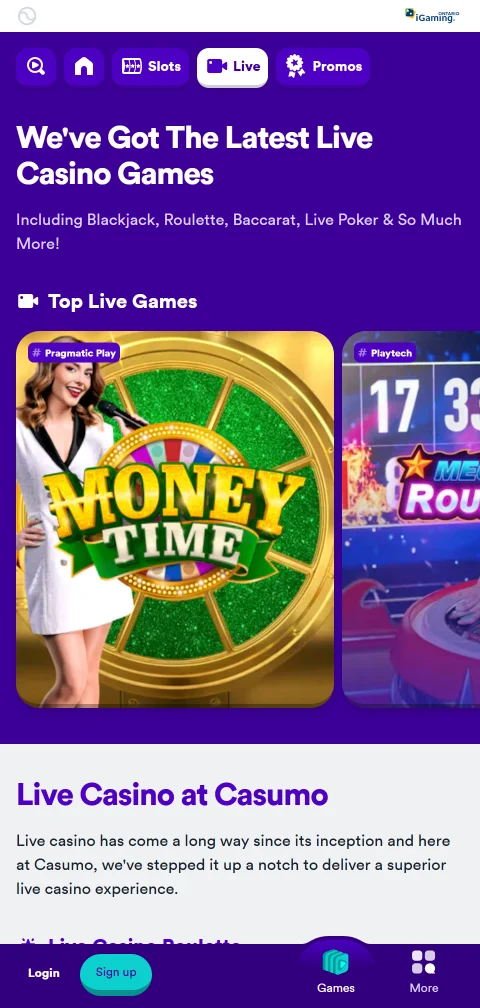
- Over 5,300 games with strong live casino coverage from Playtech and Pragmatic Play.
- Native iOS and Android apps with Face ID and Touch ID sign-in.
- MuchBetter withdrawals clear in hours, and Interac deposits are instant.
- Malta Gaming Authority licence plus Swedish, Spanish, and UK regulatory approvals.
- Clean lobby and quick-launch spotlight make games easy to reach on mobile.
- Welcome bonus value still depends on the 30x wagering and $5 max bet rules.
- Casumo Casino is currently unavailable to players in Ontario.
- Card withdrawals can take two to three days, slower than MuchBetter payouts.
- Live chat can escalate tougher payment questions, adding up to a day to resolve.
When comparing options, this Casumo Casino review is useful for its plain-language breakdown of promotions, mobile play, and the player protections that matter most. We confirmed the 100% up to $500 welcome offer, the 30x wagering requirement, and the Interac and MuchBetter payout speeds Canada players can realistically expect.
How we ranked casinos for Quebec players
The ranking is built from published documents: licence registers, bonus terms, banking pages and support policies, read in both English and French where the operator offers both. Commission arrangements with operators do not move a placing, and neither does the size of a headline bonus on its own.
Bonuses and their terms for Quebec accounts
A welcome offer with wagering at or below 35x the bonus, a stated maximum bet and a clear list of excluded games raises a placing. Wagering above 50x, a cap on winnings hidden in a separate document, or terms that exist only in English while the casino markets itself in French lowers one, because a Quebec player is entitled to understand the contract they accept.
Banking in CAD and payout speed
Accounts held in Canadian dollars with Interac deposits and withdrawals raise a placing. Forced conversion to euros or dollars US, withdrawal fees, or a stated processing window beyond three business days lowers it. We also check whether the casino names the cases in which Desjardins members need another method.
Games, software and certified RTP
A library from studios that publish RTP figures and hold testing-lab certificates raises a placing, as does a game information screen that shows the RTP version actually running. Unnamed in-house slots with no certificate, or a live casino with no French-speaking tables, lowers one. Library size alone earns nothing: a thousand titles without audit records count for less than four hundred with them.
Mobile use and French interface
A mobile site or app that keeps the full cashier, the limit tools and the bonus terms available in French raises a placing. A mobile version that drops self-exclusion settings, or switches to English once the player reaches the cashier, lowers one, since those are the tools a player needs most on a phone.
Licensing and trust on record
A licence that can be confirmed on the regulator’s own public register, under the same company name that appears in the site footer, raises a placing. The KGC and the MGA both publish searchable registers and run complaint processes. A Curaçao reference that leads to no register entry, a footer with no company number, or a mismatch between the licensed entity and the one named in the terms lowers a placing sharply. This criterion can remove a casino from the list outright, whatever its other scores.
Customer support in French and English
Live chat staffed in French for at least part of the day, a written escalation route and a named dispute body in the terms raise a placing. Support available only by email, an answer that contradicts the published terms when we asked a question, or no mention of where an unresolved complaint goes lowers one. We quote support answers only where the operator has put the same rule in writing, since a chat agent’s assurance does not bind the company in a dispute.

How online gambling is legal in Quebec
Canada leaves gambling to the provinces. Section 207 of the Criminal Code allows a provincial government to conduct and manage lottery schemes, which includes online casinos, and in Quebec that role belongs to Loto-Québec, a Crown corporation. Its online casino, live casino and the Mise-o-jeu sportsbook are the only platforms the province itself operates.
The Criminal Code targets those who run unauthorized gambling, not the people who play. No federal or Quebec law makes it an offence for an adult in the province to open an account with an offshore casino, and that is why sites licensed in Kahnawake, Malta or Curaçao continue to accept Quebec residents in large numbers.
The legal age in Quebec is 18, a year younger than in Ontario or British Columbia.
The Kahnawake exception
The Kahnawake Gaming Commission sits on Mohawk territory just south of Montreal and has licensed online operators since the late 1990s. Its authority rests on the community’s position that gaming regulation falls within its own jurisdiction, a position the province has never formally accepted and never successfully challenged. For a Quebec player, the practical point is simpler: a KGC licence comes with a public register and a complaint procedure, which many other offshore licences do not offer.
Loto-Québec or an offshore licence: what each protects
The choice most Quebec players face is not between a legal and an illegal site. It is between a provincial operator with domestic oversight and a private one whose rules are set by a regulator abroad, and each gives up something the other keeps.
The comparison below draws on Loto-Québec’s published account rules and on the licence conditions of the main offshore regulators.
Loto-Québec online | Offshore-licensed casino |
|---|---|
| Operated by a Quebec Crown corporation; proceeds stay in the province | Licensed by Kahnawake, Malta or Curaçao; no Quebec authority over the operator |
| Weekly deposit limit compulsory at sign-up, from $25 to $9,999 | Limits available but usually optional and set by the player |
| Smaller game library and modest promotions | Larger libraries, more live tables and bigger welcome offers with wagering |
| Bank withdrawals to an account in the same name; 3 to 5 business days at the bank | Interac and e-wallet payouts often stated within 24 to 72 hours, varying by site |
Bill 74 and why blocking never took effect
Quebec is the only province that tried to wall off offshore casinos by law. Bill 74, adopted in 2016, would have required internet service providers to block sites on a list drawn up by Loto-Québec, within 30 days of receiving it and under fines of up to $100,000.
The telecommunications industry challenged it immediately. The Superior Court of Québec struck the provisions down in 2018, and the Court of Appeal confirmed that ruling in 2021, finding that the blocking regime intruded on federal jurisdiction over telecommunications and criminal law. Both courts also concluded that the law’s dominant purpose was to steer players toward Loto-Québec rather than to protect consumers, which removed the province’s main constitutional argument.
No blocking regime applies in Quebec today.
The episode still shapes the debate. It showed that the province cannot close its market from the network side, so any change has to come from licensing rather than prohibition.
Depositing and withdrawing from Quebec
Payment routes in Quebec have one local peculiarity: Desjardins, the province’s largest financial cooperative, does not support Interac e-Transfer at Loto-Québec, according to the operator’s own payment FAQ. Several offshore sites report similar refusals for some members.
The table summarises the methods most often offered to Quebec accounts, with figures taken from operator payment pages rather than from our own transactions.
| Method | Loto-Québec | Offshore sites | Quebec caveat |
|---|---|---|---|
| Interac e-Transfer | Yes, $20 minimum, no fee | Widely offered | Not with Desjardins at Loto-Québec |
| Visa / Mastercard Debit | Yes | Often deposit only | Useful fallback for Desjardins |
| Credit card | Canadian issuers only | Frequently declined | Some banks block gambling charges |
| Bill payment | Yes, 3 to 5 business days | Rare | Slowest deposit route |
| E-wallets | No | Common | Check fees on CAD conversion |
| Crypto | No | Offered by some | No Interac-style recourse on errors |
What would change if Quebec opens its market
The October 2026 provincial election brought the question back. The Parti Québécois, which formed the new government, and the Quebec Liberal Party both campaigned on ending Loto-Québec’s online monopoly and licensing private operators, while the outgoing Coalition Avenir Québec opposed it. The Liberal proposal named the Régie des alcools, des courses et des jeux as the regulator.
Until a bill is tabled and passed, none of this alters a player’s position. Ontario’s experience gives an idea of what licensing usually brings, though Quebec’s version would be written by Quebec.
Checking an offshore casino before signing up
While licensing for private operators does not exist in Quebec, the checks fall to the player. These five take a few minutes and come from the documents every legitimate operator already publishes.
- Step 1
Confirm the licence on the register
Find the licence number in the footer and search it on the regulator's own site, such as the KGC or MGA register. The company name must match the one in the terms. - Step 2
Read the bonus terms before accepting
Note the wagering multiple, the maximum bet while wagering, excluded games and any cap on winnings. If these rules appear only in English, ask support whether a French version exists. - Step 3
Check banking in Canadian dollars
Make sure the account currency is CAD and that the method you plan to deposit with also pays out. Desjardins members should confirm an alternative to Interac first. - Step 4
Set limits before the first deposit
Offshore sites rarely impose a deposit limit the way Loto-Québec does. Set daily or weekly limits yourself from the responsible gambling page before funding the account. - Step 5
Find the complaint route in writing
Locate the dispute procedure in the terms, including the regulator or ADR body that handles unresolved complaints. Without one, a refused withdrawal has nowhere to go.
Bonus clauses Quebec players misread most
Most disputes we see described by players start with a clause that was in the terms from the beginning. The maximum bet rule is the usual one: a casino may cap stakes at $5 while a bonus is active, and a single larger spin can be enough to void the winnings.
Game weighting comes next. Slots usually count in full toward wagering, while blackjack or live tables may count at 10% or not at all, so the same 35x requirement means very different play depending on what you choose.
Read the winnings cap.
Quebec’s Consumer Protection Act generally requires clear contract terms for consumers in the province, but an offshore operator’s terms are usually governed by the law of its licensing jurisdiction. That gap is the reason a French translation matters less than the existence of a regulator who will act on a complaint.
Taxes on gambling winnings in Quebec
Recreational gambling winnings are not taxed in Canada, and Revenu Québec follows the federal position. A jackpot won at Loto-Québec or at an offshore site is treated as a windfall, not income, whatever its size.
The exception is gambling run as a business, judged on frequency, method and dependence on the income. Interest earned once the winnings sit in a bank account is taxable as ordinary investment income, like any other savings.
Gambling responsibly as a Quebec player
Loto-Québec makes a weekly deposit limit compulsory when an account is opened. Offshore casinos usually leave that decision to you, which means the protection exists only if you switch it on yourself. Set a deposit limit and a session reminder before the first deposit, not after a losing evening, and treat any money staked as the cost of entertainment rather than a way to earn.
Self-exclusion at one offshore casino does not carry over to another, since each operator keeps its own list. If gambling has started to cost more time or money than you planned, the helplines below offer free, confidential support in French and English.
Where Quebec players stand today
The figure to keep from this page is the one nobody advertises: the weekly deposit limit Loto-Québec forces on every account, and which no offshore site on the list imposes. If you choose an offshore casino, recreate that limit yourself before the first deposit. The ranking will be redone once Quebec adopts a licensing law, because a provincial licence would then outweigh any offshore one. The legal framework and operator terms were last reviewed on 13 November 2026.
Questions about online casinos in Quebec
Is it legal to play at online casinos in Quebec?
Yes for the player. Loto-Québec runs the province’s own online casino, and no federal or provincial law makes it an offence for an adult resident to play at an offshore site. The Criminal Code is aimed at operators who run unauthorized gambling, not at the people who place bets.
What is the legal gambling age in Quebec?
The minimum age is 18, both at Loto-Québec and at land-based casinos in the province. That is a year younger than Ontario and British Columbia. Offshore sites set their own minimum, and a few require 19 or 21 regardless of province, so check the terms before registering.
Does Quebec block offshore casino websites?
No. Bill 74 tried to force internet providers to block sites listed by Loto-Québec, but the Superior Court struck it down in 2018 and the Court of Appeal confirmed that decision in 2021. No blocking regime applies, and access to offshore sites is unrestricted at the network level.
Which licence should an offshore casino hold for Quebec players?
Look for a licence you can confirm on a public register, most often from the Kahnawake Gaming Commission or the Malta Gaming Authority. Both publish licensee lists and run complaint procedures. A licence reference that leads to no register entry offers no practical protection if a withdrawal is refused.
Why does Interac not work with my Desjardins account?
Loto-Québec states that Interac e-Transfer is not available with certain institutions, Desjardins included. Its suggested alternatives are Visa Debit, Mastercard Debit, a Canadian credit card or bill payment, which takes three to five business days. Offshore casinos vary, so confirm the method before depositing.
Will Quebec license private online casinos?
Both the Parti Québécois and the Quebec Liberal Party campaigned in 2026 on ending Loto-Québec’s online monopoly. No licensing law has been adopted. Until one is passed and a regulator starts issuing licences, private sites serving Quebec remain licensed abroad and Loto-Québec stays the only provincial operator.
More about online casinos






Look first at the licence line on each card rather than the bonus. A Kahnawake or Malta licence comes with a public register and a complaint route; the welcome offer comes with wagering.